2026-04-02 · 8 min read
Why particles feel difficult at first
Many beginners memorize particles as isolated rules and get stuck. A better approach is to learn each particle by sentence role.
When you connect particles to meaning flow, your reading and listening confidence rises quickly.
Start with role-based core set
Focus first on core particles: subject/topic, object, location/time markers.
Do not learn everything at once. A stable core set gives better accuracy in early quiz sessions.
How to practice with short loops
Use one sentence pattern and rotate nouns instead of collecting too many unrelated examples.
Five to ten focused repetitions with immediate feedback are more effective than long passive reading.
Common beginner errors
A common mistake is forcing direct translation from English structure. Korean particles often encode roles differently.
Another mistake is skipping review when answers look familiar. Familiarity is not retrieval mastery.
How WordCraftVillage helps
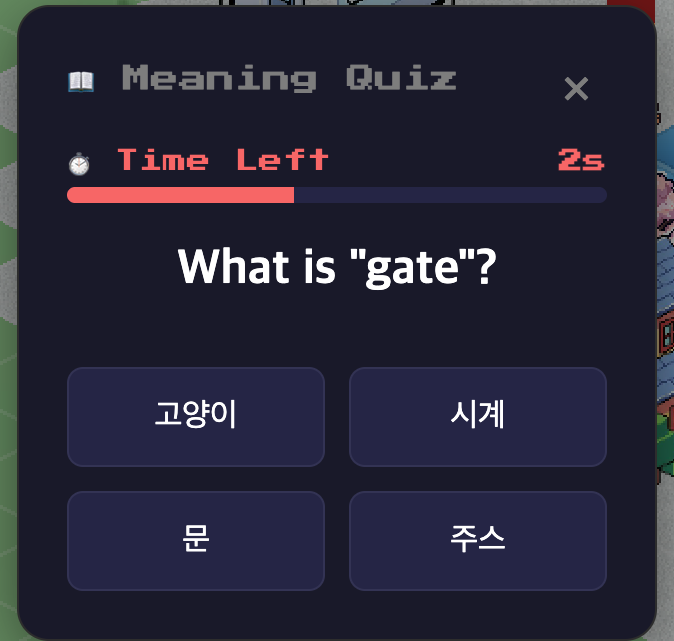
Deck progression keeps difficulty manageable while repeated quiz exposure strengthens sentence-role mapping.
Use review-focused sessions when your accuracy drops after switching to a higher deck.
Weekly checkpoint
Track two metrics: accuracy trend and error type (role confusion vs vocabulary miss).
If role confusion persists, reduce new words and run one week of focused review before expanding difficulty.